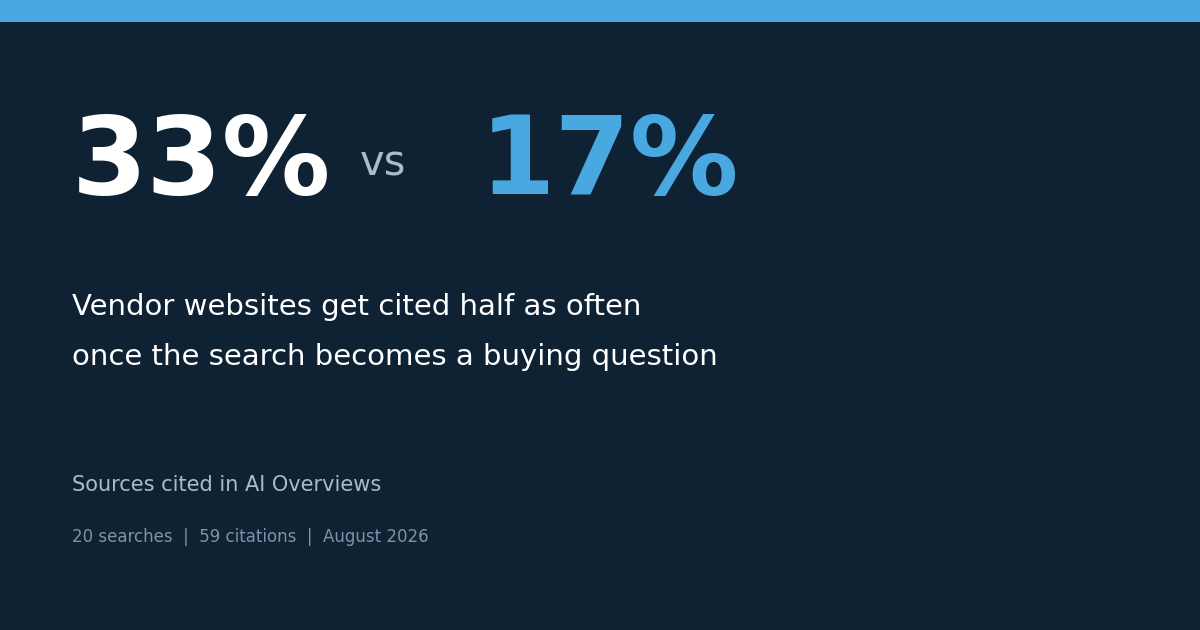
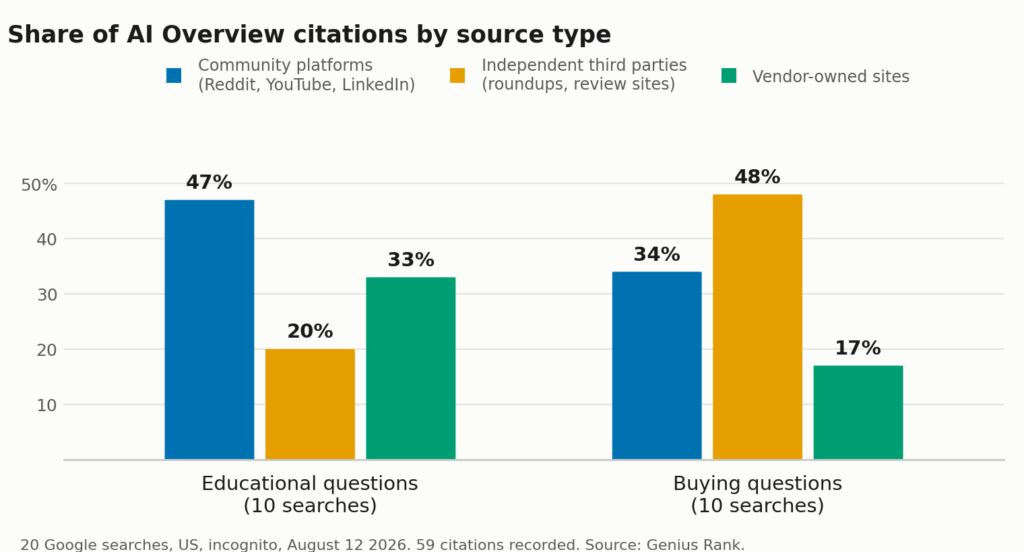
The pattern is consistent across the set and it makes sense once you see it.
When someone asks what generative engine optimization is, a vendor explainer is a reasonable source. The company knows the topic and the answer does not involve choosing between competitors.
When someone asks which tool is best, the system appears to weight sources with no stake in the outcome. Zapier roundups, G2 review data, Reddit threads and independent bloggers filled that space repeatedly across our ten buying questions.
So the closer a search sits to a purchase, the less your own content appears inside the answer. Most teams have their AI visibility effort pointed at exactly the wrong end of that curve, because on-page work is the easiest thing to plan and the easiest thing to report.
Reddit or YouTube Appeared in 15 of 20 Searches
Reddit was in the top three cited sources on 10 of the 20 searches. YouTube on 8. Together they appeared in 15 of 20.
On “semrush vs ahrefs”, two of the three sources were Reddit threads and the third was a YouTube video. Not one vendor page.
On “best local seo software”, the sources were a Reddit thread, a G2 profile and an independent blog.
Ahrefs found the same thing at a scale we cannot match. Ahrefs’ June 2026 ranking of the 50 most-cited websites in Google AI Overviews puts YouTube first at 21.1% of citations, from 1,724,069 citations counted, and Reddit second at 18.5%, from 1,060,529. Two platforms, neither of them a vendor, taking almost 40% of everything cited.
In a separate March 2026 analysis of 863,000 keyword SERPs and 4 million AI Overview URLs, they also found YouTube supplied 18.2% of the citations that came from pages not ranking in the top 100 at all.
For a competitive comparison query in your own category, the useful question is not how your comparison page ranks. It is whether anyone in the relevant subreddit has said anything accurate about you in the last two years.
How This Fits With the Larger Studies
Our sample is 20 searches. Several published studies are far bigger, and they answer a different question.
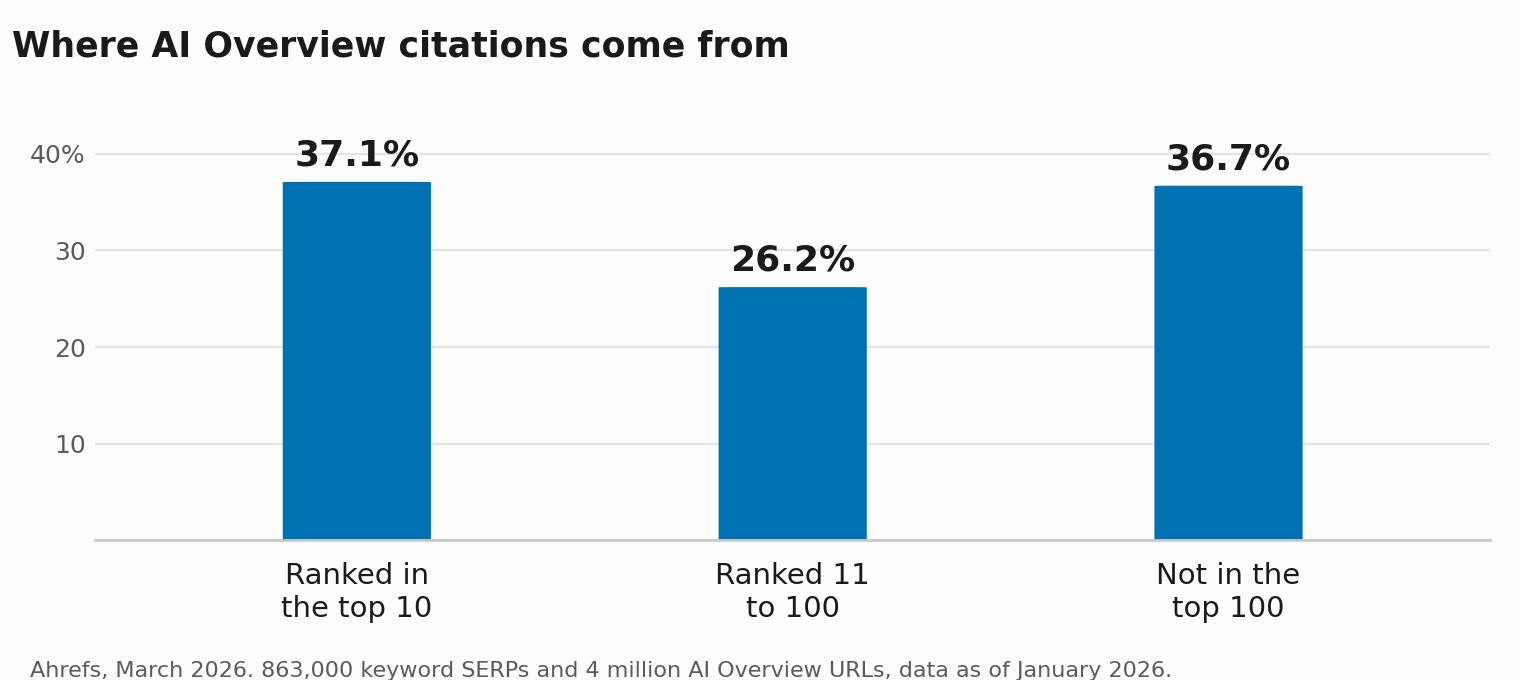
Ahrefs analyzed 863,000 keyword SERPs and 4 million AI Overview URLs in January 2026. They found that 37.1% of AI Overview citations come from pages ranking in the top 10, 26.2% from positions 11 to 100, and 36.7% from pages that do not rank in the top 100 at all. That last figure is the one worth sitting with. More than a third of cited pages are invisible in normal search results.
They also reported a sharp change over time. In July 2025 the share coming from the top 10 was 76%. By January 2026 it was 37.1%. Google is relying less on ranking position and more on pulling from related searches.
Worth flagging that the published numbers do not agree with each other. BrightEdge reported in February 2026 that only about 17% of sources cited in AI Overviews also rank in the organic top 10, less than half of what Ahrefs measured. Different samples, different months, different methods. Anyone quoting a single figure as settled fact is overselling it, ourselves included.
Those studies measure which pages get cited across the web. Ours measures something narrower: whether the type of source changes with buying intent inside one category. Both are useful, and the second question needs a small controlled set rather than a large uncontrolled one, because the comparison only works if the two groups are chosen deliberately.
What This Changes About Where You Spend
Four things follow from the numbers above.
1. Run your own version before you plan anything
Pick 20 questions your buyers actually ask, split them evenly between learning and buying, run them, and log the first three sources of every AI Overview. It takes an afternoon and the result will not match your rank tracker. That list of cited URLs is your real competitive set.
2. Move budget toward the sources that appear on buying questions
If a Zapier-style roundup, a G2 profile or a review site keeps appearing across your commercial queries, those pages are shaping the answer at the exact moment money is involved. Getting your listing accurate and current on them is cheaper and faster than another blog post.
3. Treat community presence as infrastructure, not campaigns
Reddit and YouTube sat in the top three sources on 15 of our 20 searches. You cannot buy your way in and you should not try. You can answer questions honestly under a real identity, correct wrong information about your product, and accept that this compounds slowly. Our practical playbook for ranking in AI search covers the sequence.
4. Tell your audience about Preferred Sources
In May 2026 Google brought Preferred Sources to AI Overviews and AI Mode, which lets a reader mark the publications they want to see more often, alongside new “Highly Cited” labels for influential coverage. It is the one lever in this whole picture that a reader can pull on your behalf, and almost nobody is asking them to.
One expectation to set before anyone promises results. Pew Research Center found that when an AI summary appeared, users clicked a link inside it on 1% of visits, and clicks on regular results fell from 15% to 8%. AI citations behave like brand impressions, not like an acquisition channel. Track the share of your question set where your brand is named at all, measure it monthly, and keep the question list identical every time.
Method, Sample Size and Limits
We are publishing the limits alongside the findings, because a 20-query study that pretends to be more than it is deserves to be ignored.
Sample size
Twenty searches and 59 citations. Large enough to compare two groups of ten, too small to describe the whole web. The educational versus buying split is the finding we stand behind. The exact percentages will move if you rerun it.
Single point in time
All 20 searches ran on August 12, 2026. AI Overviews change week to week, and the Ahrefs data above shows how fast: the top 10 share fell from 76% to 37.1% in six months.
One category and one market
Every query sat in SEO and marketing software, run on United States results in an incognito window with personalization off. A different industry may produce a different split, which is exactly why the method matters more than our numbers.
What we logged
Sources panel entries only, first three per query. The raw data is a simple spreadsheet: query, question type, whether an AI Overview appeared, and the first three sources with their classification. Anyone can rebuild it in an afternoon, and we would rather people ran their own than cited ours. If you want the method in more depth, see our guide on how to get cited by AI assistants.
Final Thoughts
The interesting number in this study is not the 75%. Larger studies already established that AI answers lean on sources outside the brands they discuss.
The interesting number is the gap between 33% and 17%. It says that the influence of a company’s own website inside an AI answer is not constant. It shrinks as the searcher gets closer to buying, at exactly the point where being named matters most.
That is uncomfortable, because the work it implies sits on domains you do not control and cannot schedule. Updating a review profile, earning a place in someone else’s roundup and being talked about accurately in a forum are slower and messier than publishing another article.
They are also, on the evidence here, where the citations are.
Genius Rank
Genius Rank combines AI reputation tools with a vetted business community of 500+ members across 50+ industries. The platform runs SEO audits, competitor intelligence and reputation monitoring, and publishes its pricing openly at $0, $49 and $199 a month.
See how AI search engines perceive your brand. Join 500+ vetted businesses building their digital authority on Genius Rank. Apply free today.